


How to Remove Corrosion from a Car Battery
Pop the hood on almost any car after a couple of years, and there's a decent chance you'll spot it: a chalky, blue-white crust creeping around the battery posts. That's battery corrosion, and it's one of those small, easy-to-ignore problems that has a way of turning into a bigger one. Who has time for a no-start morning? At Bell & Bell GMC in Little River, our service team hears this question all the time, so here's a straightforward rundown of how to handle it safely.

Key Takeaways
- Battery corrosion is a chalky buildup caused by escaping gases reacting with heat, humidity, and the metal terminals.
- A simple baking soda and water solution neutralizes most corrosion safely.
- Always disconnect the negative terminal first, and wear gloves plus eye protection.
- Left alone, corrosion can cause hard starts, flickering electronics, and permanent terminal damage.
- If corrosion keeps coming back, or the battery is several years old, it's worth having it tested.
How Do You Remove Corrosion From a Car Battery?
The short version: mix baking soda with water, disconnect the battery (negative terminal first), scrub the buildup with a stiff brush, rinse it off, and dry everything thoroughly before reconnecting. It's a five-minute job for most vehicles, and it doesn't call for anything exotic from the parts aisle.
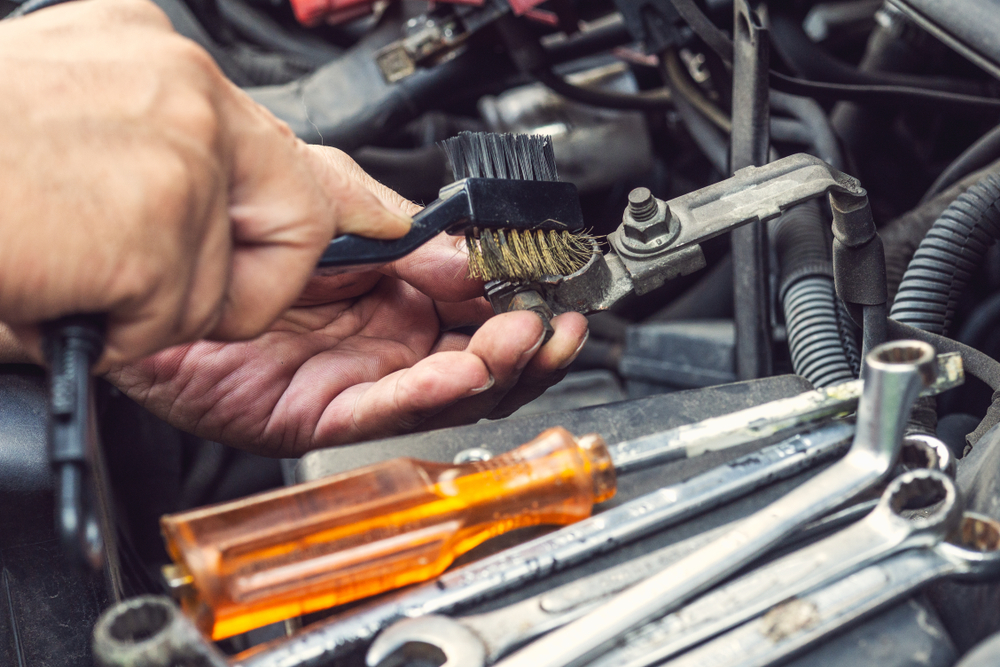
Knowing how to clean battery corrosion properly starts with safety. Battery acid is nasty stuff, so gloves and eye protection aren't optional — treat it as you would any household chemical that can burn skin or eyes. Once geared up, loosen the negative clamp first, then the positive, and set both cables aside so they can't touch the posts while working. Mix roughly a tablespoon of baking soda into a cup of water; it'll fizz a bit when it hits the corrosion, a sign it's neutralizing the acid causing the damage. A stiff wire brush, or even an old toothbrush, works the paste into the buildup around the posts and clamps. For a car that sits outside near the coast, or one that's a few years old, this corrosion can reappear faster than expected, so it helps to glance under the hood every so often rather than waiting for a rough morning to notice it.
What You'll Need
- Rubber gloves and safety glasses
- Baking soda and water (about 1 tablespoon to 1 cup)
- A stiff wire brush or old toothbrush
- A wrench sized for the terminal clamps
- Terminal grease or a dab of petroleum jelly
Step-by-Step: How to Clean Battery Corrosion
- Gear up: Put on rubber gloves and safety glasses before touching anything. Battery acid residue can irritate skin and eyes, so this step isn't optional.
- Check for leaks first: Look at the tray and casing around the battery. If it's wet or the case looks swollen, skip the cleaning and have a technician inspect it instead.
- Disconnect the terminals: Loosen the negative (–) clamp first and move it out of the way, then do the same for the positive (+) clamp. Keep both cables from touching the posts.
- Mix the cleaning solution: Stir about a tablespoon of baking soda into a cup of water until it dissolves. A store-bought battery cleaner works too, especially for heavier buildup.
- Apply and scrub: Pour or brush the solution onto the corroded areas. It'll bubble as it neutralizes the acid — that's normal. Work it in with a stiff brush until the buildup lifts.
- Rinse and dry: Rinse the posts and clamps with a small amount of clean water, then dry everything thoroughly with a rag. Leftover moisture invites corrosion right back.
- Reconnect and protect: Reattach the positive clamp first, then the negative. Once secure, add a thin layer of terminal grease or petroleum jelly to help slow future buildup.
What Causes Car Battery Corrosion?
Corrosion forms when hydrogen gas and acid vapor escape from the battery and react with heat, moisture, and the metal terminals. It's a slow chemical process on its own, but heat, humidity, and road salt all speed it up considerably.
Every car battery vents a small amount of gas as it charges and discharges, and that vapor doesn't just disappear — it settles on the nearest metal, which happens to be the terminals and cable clamps. Combine that with under-hood temperatures that can climb well past 200 degrees in summer, and the reaction speeds up fast. Along the coast, salt air and humidity add another layer, since moisture gives the acid vapor something to cling to and react with. Older batteries tend to vent more as their internal seals wear down, which is part of why corrosion shows up more often on a battery that's three or four years old than on a brand-new one. A loose clamp doesn't help either — any gap around the post gives vapor an easier path out.

This table helps compare the main factors behind battery corrosion at a glance.
| Factor | Impact | Example | Explanation |
|---|---|---|---|
| Heat under the hood | Speeds up vapor release | Summer temps near Little River | Heat accelerates the chemical reaction that forms corrosion |
| Humidity | Adds moisture for the acid vapor to react with | Coastal South Carolina air | Humid air speeds up around the posts |
| Road salt | Leaves conductive residue on terminals | Winter road treatments | Salt residue reacts with the battery posts |
| Battery age | Older seals vent more vapor | Batteries three-plus years old | Aging batteries corrode more often |
| Loose connections | Creates gaps for vapor to escape | Vibration-loosened clamps | Loose clamps let more vapor reach the terminal |
Is It Safe to Drive With a Corroded Battery Terminal?
For a short trip, probably — but it's not something to put off. Corrosion interrupts the connection between the battery and the rest of the electrical system, and that can show up as anything from a sluggish start to a full no-start with zero warning.
A corroded battery terminal creates resistance right where the vehicle needs a clean, strong connection. Drivers often notice it first as slow cranking on a cool morning, dimmer-than-usual headlights, or dashboard warning lights that flicker at idle. Modern vehicles are especially sensitive to this, since infotainment systems, safety sensors, and stop-start technology all draw power through that same connection. None of that is usually an emergency on day one, but corrosion doesn't improve on its own. It builds gradually, and by the time a battery won't turn the engine over at all, the buildup has often been forming for weeks. Catching it early, with a quick visual check under the hood, beats getting stranded in a parking lot.
Wrapping Up
Battery corrosion isn't complicated once it's understood, and it's one of the easier maintenance tasks to handle before it becomes a bigger headache. A little baking soda, a stiff brush, and some care around the terminals go a long way toward keeping a vehicle starting reliably. For drivers in Little River who'd rather have a professional take a look, Bell & Bell GMC's service team can clean, test, and — if it's time — replace a battery in about the time it takes to grab a coffee nearby.
Noticing white buildup around the battery posts, or dealing with a car that's been slow to start lately? Scheduling a quick battery check at Bell & Bell GMC is an easy next step — no guesswork required.
FAQ
How often should battery corrosion be cleaned?
Checking every few months is a good habit, especially before summer and winter when temperature swings are toughest on batteries. If corrosion shows up faster than that, it's worth having the battery and charging system tested.
Can vinegar be used instead of baking soda?
Vinegar is acidic, so it doesn't neutralize corrosion the way baking soda does — sticking with a baking soda and water mix is the safer bet.
Does corrosion mean the battery needs to be replaced?
Not necessarily. Corrosion is often just surface buildup that cleans off easily, though a battery that corrodes repeatedly or is several years old should be tested.
What color is battery corrosion usually?
Most corrosion looks white, blue-green, or a chalky ash color, depending on the metal in the terminals and the battery's age.
Should the battery be removed from the vehicle to clean it?
Usually not. Disconnecting the terminals is enough for most cleaning jobs; removing the battery entirely is only needed for severe corrosion or when replacing the terminals.
-
Bell & Bell GMC
2491 Hwy 9 East
2491 Hwy 9 East
Little River, SC 29566
- Sales: (843) 353-0095
Loading Map...